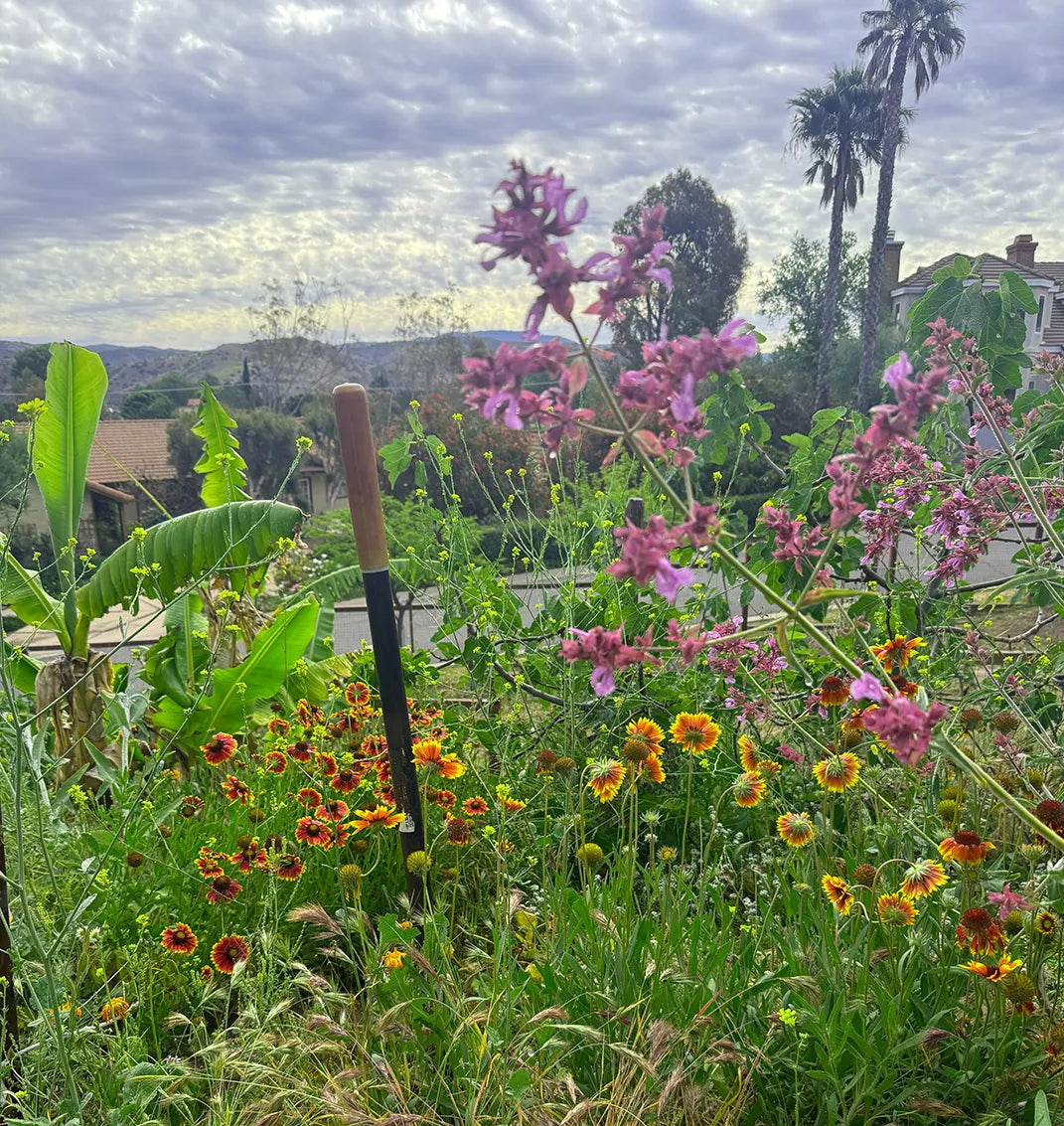
Chaos. It’s everything we Americans hate. We prefer our grass to be green like the fairways at Augusta, and maintained tighter than a drill sergeant’s high-top fade. Fear not. This isn’t a particularly political post, but I do have a strong suspicion that what our fellow citizens are pleading for when they pledge to “Make America Great Again” has something to do with the restoration of order and stability. The threat of globalism and immigration has made Americans fear “the Other” and the loss of the control that once snuggled them like a tightly tucked blanket. But, as Nietzsche once said, out of chaos comes order. "Ah, Blow it out your ass, Howard!” Okay, a philosophical treatise isn’t what I’m here to preach either. Well, mostly not. A gospel of disorder is more of what I had in mind.
This past year, I let my American instinct to control my garden be damned. I broadcast cover crop (mostly white clover, vetch, and peas) amongst the trees in the orchard. Flinging zinnia, echinacea, radish, and turnip seeds between rows in the vineyard. I imagined the widow across the street peeking out her kitchen window, watching me tear open packets and tossing seeds about like confetti, convinced I’d finally succumb to mental illness. Then the kids came home for winter break, and we all traveled to Japan for the New Year. Jen and I were wrestling the whole time with whether or not now was the time to buy a farm. Our retirement dream of working the land in the Central Coast manifesting a decade before we had imagined. The farm had everything we dreamed of - water, citrus orchard, two dwellings, a commercial kitchen, a view atop the canyon, and did I mention water? A rare and precious commodity in Central Coast farmland. The day after we returned from Tokyo we made the offer, and now, somehow, Summer is upon us.
I returned to Southern California this past week to a heatwave. Temperatures bordering on three digits, that in most years would dry out the soil, and shrivel the flowers that were just starting to show their true colors. To my surprise, the orchard I had all but abandoned the past few months is the healthiest it has ever been. To create the orchard and the terraced vineyard, we had planted on hard earth imported from pool builders across Orange County. The County even demanded that we hire a geologist to ensure that the earth we brought onto our property was compacted to a rate of 85 to 90%. We were left with hard, salt-laden land that was less than eager to grow. I amended the soil with nutrients and compost, mixing in nitrogen from the chickens' waste, urine-soaked bedding, and goat droppings. The grape vines have never looked so healthy and abundant.

In the orchard, something altogether more surprising occurred: harmony! This is where I digress briefly to share my love for all things Kurosawa. The filmmaker, that is. As an undergraduate, I studied with a professor who in the 1960s had entered the seminary and then, after a nearly fatal motorcycle accident, had an awakening (literally, after spending weeks in an induced coma) that film school was his true calling. Attending USC, he became a student of Japanese Cinema. As a professor he shared that passion with his students. Exposing us, as most students are in post-WWII cinema classes, to the Japanese master. For many, that’s the first and last spot they’ll watch The Seven Samurai, a film we know (because George Lucas said as much) was a huge influence on the creation of Star Wars. Seven Samurai be damned, because it was Kurosawa’s High and Low that lit my fire for Japanese Cinema. A film that first follows the victims of a kidnapping, and then later, without much warning, switches perspective to follow the kidnapper. I’ll spare you the spoilers, as Spike Lee has just released his trailer for his own New York-centered remake. But this shift of perspective blew my mind. What can I say? I was an eighteen-year-old film student. We’re easily impressed at that age.
Kurosawa’s films were a gateway drug to a lifelong passion for all things Japanese. I’ve spend the twenty-five years since collecting ephemera: vintage movie posters, fashion rags, handbills. Truth be told, my passion for Japanese culture probably started in the third grade when my parents let me stay up to watch the original Shogun mini series. Amongst these collectibles is a book: The One Straw Revolution by Masanobu Fukuoka. It’s my inspiration to be a farmer. Or better said to be a conscientious one. It’s a short read, though I believe deserving of a place in the holy trinity of concise manifestos along with Suzuki Roshi’s Zen Mind, Beginner’s Mind and Strunk & White’s The Elements of Style. It’s packed full of lessons both on life and the farm. As his editor Larry Kohn, puts it, “Mr. Fukuoka farms by cooperating with nature, rather than trying to improve on nature by conquest.”
This is what we’re doing isn’t it? Here in America? My neighbors spending their Saturdays on their hands and knees removing weeds from their Miracle Grown lawns. They aren’t cooperating with nature; they’re trying to subdue it. This isn’t a criticism. I too feel their desire for order. The world spinning out of control, and creating a safe, orderly space right out our front doors seems like the right thing to do.
After visiting the farm we now call Stardust Grove, I couldn’t help but feel that it was divine intervention that brought me to this oasis. Like Fukuoka, the former owner, Mike Broadhurst, was a scientist for Big Pesticide, who gave it all up to work the land. Fukuoka discusses the state of industrial farming and the damage he saw to the land in post-war Japan. The Japanese abandoned traditional farming methods for Industrial Agricultural practices the Americans taught them, in the name of feeding their starving population. However, after the people were fed, they never returned to those conventional practices. Believing that the order Japanese farmers were inflicting on the land was doing more damage than good, Fukuoka decided to try to imitate the perfect chaos he witnessed in nature.
He observed and through experimentation, confirmed that the land was losing its fertility, year after year, with the use of industrial fertilizers. And by tilling the land, the depleted soil became dependent on those fertilizers, and the monoculture of crops dependent on industrial pesticides. This seems obvious now, but in the 1970s, when Fukuoka was repairing his own farm, this wasn’t popular opinion. Even today, given our current knowledge, most Americans prefer large-sized, brightly colored, and blemish-free, industrially sanitized fruits and vegetables. Even though it’s been scientifically proven that this produce is lacking in the most significant department: nutrition. Fukuoka believed the antidote was a method of natural farming to reverse the degenerative (ergo regenerative farming) momentum of modern industrial farming.
Like most farmers and homesteaders of our generation, we spend a lot of time and energy on YouTube absorbing all we can. But I propose that this little manifesto of Fukuoka’s provides all the knowledge one needs to become an instrument of chaos. The One Straw Revolution is a blueprint for cultivating nutritious produce while simultaneously repairing the damage we’ve done to our soil. And imagine if all the farmers, new and old, did the same. While our produce might not always look neon in color, it’s our job as farmers to share the knowledge that our fruits and vegetables pack a more nutritionally dense pound-for-pound punch. This is the Revolution Fukuoka was speaking of. Each of us taking dominion of the earth below our feet - neighborhood garden or farm. Not merely for delicious produce, but for the nutritional development and health of our children and grandchildren.